Emergency preparedness and civil safety

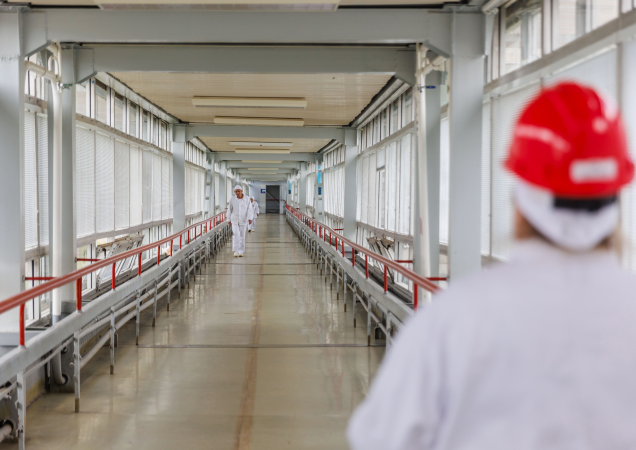
Darbuotojai su geltonais šalmais eina stikline perėja Ignalinos atominėje elektrinėje.

The operation of nuclear energy facilities requires exceptional attention to safety and continuous technical maintenance. Following the end of active operations at the Ignalina Nuclear Power Plant, the situation at the facility is stable. After the cessation of electricity production and the removal of spent nuclear fuel from the reactor units to storage facilities, the risk of potential radiological or nuclear accidents has remained minimal.

Our specialist analysis has shown that, at present, the greatest – although highly unlikely – impact could be caused by accidents resulting from external threats. External threats include events such as an aircraft crash, earthquake, external flooding, extremely low air temperature, external noise, strong wind or the fall of objects of extraterrestrial origin.

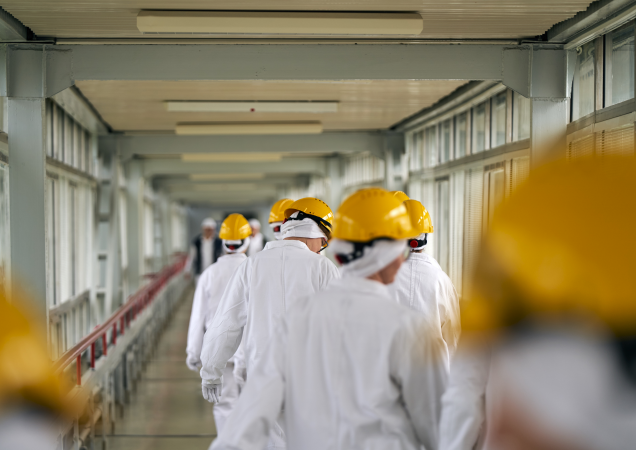
Darbuotojai su apsauginiais drabužiais vaikšto stikline perėja atominėje elektrinėje.

What is important to know

Although the probability of a nuclear accident is very low, it is important to know how public information and protection would be organised. If an accident were to occur, residents would be informed by short messages sent to mobile phones and by siren signals. Later, accurate information and recommendations for action would be provided via radio and television channels.

State and municipal institutions have prepared clear action plans to ensure the safety of residents. However, it is important that each of us knows the basic actions and is prepared to take care of ourselves and our relatives independently for at least a few days – it is recommended to have supplies for approximately 72 hours.

Warning and informing residents

To transmit messages about nuclear or radiological accidents as quickly as possible, an emergency preparedness and civil safety notification system has been established.

Information about nuclear or radiological accidents is initially provided to the Republic of Lithuania’s state management and supervisory institutions (Ministry of Energy, Ministry of Environment, the State Nuclear Power Safety Inspectorate (Valstybinė atominės energetikos saugos inspekcija – VATESI), the Radiation Protection Centre, the Fire and Rescue Department under the Ministry of the Interior, and the State Security Department). Neighbouring district (Ignalina, Zarasai, Visaginas) municipal administrations and their civil safety specialists, organisations, institutions and enterprises with units located within the sanitary protection zone of the Ignalina Nuclear Power Plant (i.e. within a 3 km radius) are also informed. Information transmission takes place at any time of day, including rest days and public holidays.

Upon receipt of notifications about nuclear or radiological accidents, the administrations of Ignalina, Zarasai and Visaginas municipalities are obliged to immediately inform the residents of their districts and implement urgent population protection measures. For informing residents, municipal administrations use civil safety notification systems, local television and media, and send cell broadcasts to mobile phones.

The Fire and Rescue Department under the Ministry of the Interior is responsible for informing residents throughout the territory of the Republic of Lithuania. Listen to announcements via the Lithuanian National Radio and Television programmes, and monitor civil safety cell broadcasts sent to mobile phones.

Residents’ actions during an accident

Actions in the event of a radiological hazard resulting in a cloud of particles of radioactive materials
  • Follow official information via Lithuanian National Radio and Television stations or local television.
  • Follow official information via Lithuanian National Radio and Television stations or local television.
  • Do not panic; warn relatives and neighbours.
  • If driving a car – close windows tightly, turn off ventilation and heating systems and fans, and cover your respiratory tract. Hurry home, to work or to another public building if you are near one. If reaching public buildings is impossible, stop in a safe place – if hot, in the shade – and with the car engine off, and listen to radio announcements. You may continue driving or exit only when the appropriate announcement is made.
  • If you are near the site of the accident or explosion – do not touch any objects as they may be radioactive.
  • Do not drink, eat or smoke in or near the contaminated area.
  • If you are outside, go indoors.
  • If you are inside a building with intact walls and windows, it is best to shelter in an interior room with as few windows as possible or in a basement If the windows are broken – if possible, choose another safe room located deeper within the building.
  • Turn off ventilation, air supply and air conditioning systems, close windows, vents and chimney dampers, cover ventilation openings, check for cracks, and seal windows and doors of the dwelling with adhesive tape.
  • Take care of children and other relatives who need assistance.
  • If it is necessary to go outside, protect your respiratory tract from dust and smoke: cover it with a disposable mask, scarf or towel. If available, wear a gas mask or respirator.
  • Herd nearby livestock and domestic animals into barns or buildings, close greenhouses, cover wells.
  • After returning from outside, be sure to remove outer clothing, take off shoes, place them in a polyethylene bag, and remove them from the living quarters. Then wash thoroughly with soap in the shower, paying particular attention to scrubbing your head.
  • Wash thoroughly any domestic animals (cats, dogs, etc.) that have been outside.
  • Only eat and drink food and beverages that have been securely sealed – canned goods, bottled drinks, tightly packaged items. Other food and water may only be consumed with permission from public health specialists.
  • Keep tuned to the Lithuanian National Radio and Television programmes, listen to the announcements and follow civil protection recommendations.
  • If you are ordered to evacuate, take the following essential items:
    • first aid kit
    • regularly used medications
    • documents (passport, birth and marriage certificates, diplomas, property documents)
    • money (cash, credit cards, securities, valuables)
    • family heirlooms, a few photos
    • non-perishable food supplies (for 2–3 days)
    • drinking water
    • necessary clothing (according to season)
    • toiletries
    • personal protective equipment (if available)
    • portable radio receiver and flashlight, spare batteries, matches, can opener
    • mobile phone and charger
If under unusual circumstances (during a transport accident, in a public place, etc.) you find or see an item marked with a radioactive sign:
  • Call the emergency telephone number 112 immediately and report the finding.
  • Keep as far away as possible from items marked with a radiation symbol or any visible source of smoke or vapour.
  • Do not touch any surrounding objects, as they may be radioactive.
  • Leave the hazardous zone as quickly as possible. Walk against the wind away from the incident site. A safe distance from the potentially contaminated zone boundary is at least 30–50 metres.
  • Advise people to move as far away as possible from the incident site until special services arrive.
  • Injured persons at the site may also be contaminated with radioactive materials.
  • Do not drink, eat or smoke in the zone where you are, as there may be contamination.
  • If possible, wait in a safe place for services to arrive and inform them about the circumstances of the incident.
  • If you left earlier than the arrival of specialists, upon returning home, change your outer clothes and place them in a polyethylene bag, wash your hands, wash your face and if possible, shower. Listen to announcements on Lithuanian National Radio and Television broadcasts and follow civil safety recommendations.

Potassium iodide use in the event of a nuclear or radiological accident

Potassium iodide tablets for thyroid protection are used only when radioactive iodine spreads in the environment and their use is recommended by the Ministry of Health.

It is recommended to take potassium iodide tablets less than 24 hours before potential inhalation or ingestion of radioactive iodine. Blocking the thyroid with potassium iodide is also effective up to 2 hours after inhalation or ingestion of radioactive iodine, but no later than 8 hours afterwards. Using potassium iodide tablets at times other than those specified may be harmful.

Recommended single doses of 65 mg potassium iodide tablets for different age groups:

Age Single daily dose of potassium iodide tablets, mg
Newborns up to 1 month 16 (quarter tablet)
Infants from 1 month to 3 years 32 (half tablet)
Children from 3 to 12 years 65 (one tablet)
Children over 12 years and adults 130 (two tablets)

More about potassium iodide tablets:

  • A single daily dose of potassium iodide tablets protects the thyroid gland from the effects of radioactive iodine for 24 hours.
  • For newborns up to 1 month old, pregnant and breastfeeding women, and those over 60 years of age, only one daily dose of potassium iodide tablets is recommended. For other population groups, in adverse emergency situations (prolonged release of radioactive substances into the environment, inability to safely evacuate people, etc.), an additional daily dose may be recommended.
  • It is advisable to take potassium iodide tablets after meals. Tablets can be dissolved in water or liquid baby foods. Dissolved tablets should be taken immediately, as the active substance decomposes rapidly.
  • Adverse effects of potassium iodide tablets occur rarely; information is provided in the leaflet inside the potassium iodide tablet package.
  • To protect the thyroid gland during a nuclear or radiological accident, it is not appropriate to use alcohol or aqueous iodine solutions, iodine sprays or iodine supplements sold in pharmacies, because they do not protect the thyroid gland from the harmful effects of radioactive iodine due to the low amount of stable iodine they contain. Alcoholic iodine solution is intended for external use only – for application to the skin. Its active ingredient is not potassium iodide, but simply iodine, which is a strongly oxidising and toxic substance that can cause chemical tissue burns and poisoning, so it should not be taken orally under any circumstances, even when diluted with water.

More detailed information can be found here.

External events

These are hazards from external events such as an aircraft crash, external noise, earthquake, strong wind, extremely low air temperature, external flooding or the fall of extraterrestrial objects.

The State Enterprise Ignalina Nuclear Power Plant has an emergency preparedness organisation with emergency preparedness plans, technical measures and resources to manage accident consequences, especially during the initial phase of an accident. Monitoring posts located within a 30 km zone around the nuclear power plant enable continuous monitoring of gamma radiation intensity. Rapid deployment of our personnel to the accident site is possible for identification of potentially contaminated areas. Radiological monitoring results with recommendations are reported to state institutions (municipalities, police, and others) and the public.

Accident classes

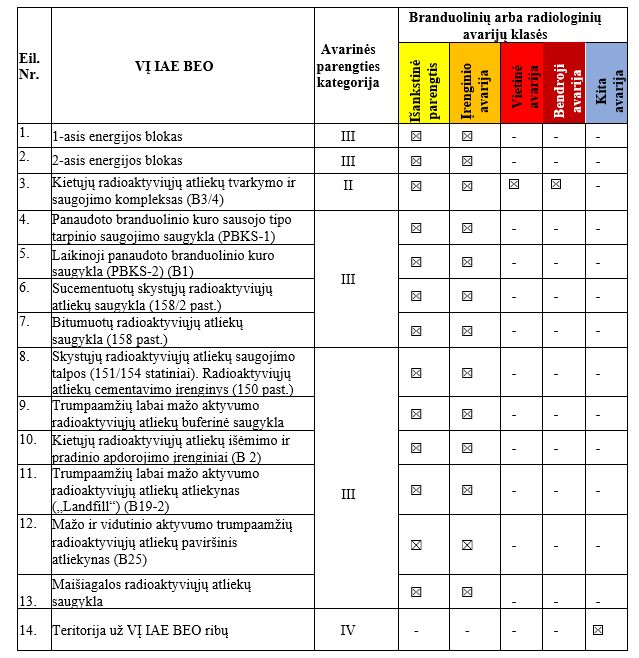
According to Lithuanian hygiene standard HN 99:2019 Protection of the population in case of nuclear or radiological accident, nuclear or radiological accidents at the Ignalina Nuclear Power Plant are classified into the following classes:

  • preliminary preparedness
  • facility accident
  • local accident
  • general accident

Accidents occurring during the transportation of radioactive materials outside the territory of State Enterprise Ignalina Nuclear Power Plant’s nuclear energy facility are classified as ‘other accidents’ and assigned to emergency preparedness category IV.

Classification of possible accidents at the State Enterprise Ignalina Nuclear Power Plant


Radiation safety training

Following the construction of the Belarusian nuclear power plant near the Lithuanian border, public and media interest in nuclear accidents and ionising radiation has increased in Lithuania. There is a large and diverse amount of publicly available information on how to behave in the event of a nuclear or radiological accident, therefore it was decided to collect, systematise and present it to the public in an attractive electronic training format in one place.

Here you can attend radiation safety training: https://radiacija.eu/emokymas/#/