Specially adapted equipment for Altra’s dismantling work tested in Germany
International cooperation
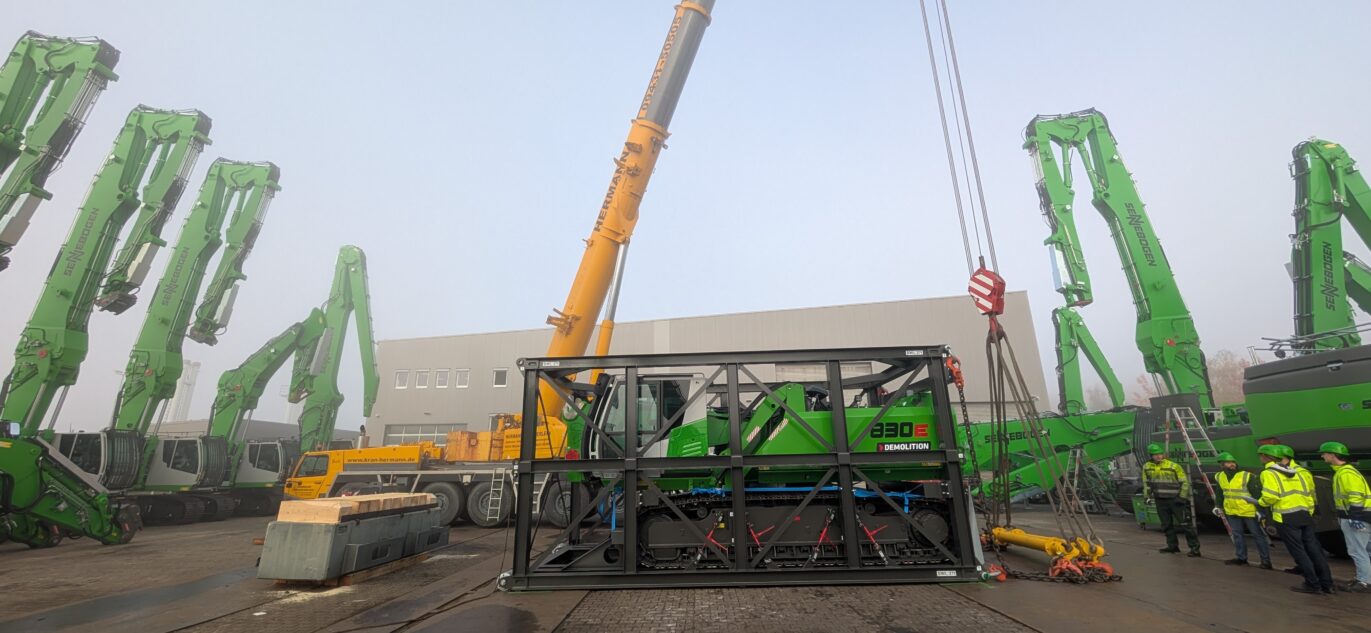
Ignalina Nuclear Power Plant, operating under the Altra name, continues preparations for one of its most complex decommissioning projects: the dismantling of the steam drum separators and associated systems. Last week, a material handling machine specially modified for this work was tested at the Sennebogen factory in Germany. The machine will be used to lift robotic equipment into hard-to-reach work areas.
During decommissioning, some work has to be carried out in areas where workers’ time must be limited due to ionising radiation, or where it is unsafe for personnel to enter. Robotics and remotely operated solutions are therefore becoming an increasingly important part of Altra’s projects.
During the factory acceptance tests, the machine was tested under different operating conditions, with its main functions and readiness for the planned tasks at Ignalina Nuclear Power Plant assessed. Weighing around 40 tonnes, the machine will be capable of performing various operations at heights of almost 20 metres.
One of its main tasks will be to lift a remotely operated BROKK robot into positions from which the steam drum separators and associated structures can be dismantled. This will allow robotic equipment to reach structures located at significant heights while reducing the need for workers to operate directly in radiologically challenging areas.
The new equipment is expected to arrive at Ignalina Nuclear Power Plant at the end of November. Once the steam drum separator dismantling project has been completed, the machine is also expected to be used for other work at the plant.
Preparing for a project of exceptional scale
The dismantling of the steam drum separators is considered one of the most technically challenging tasks in the decommissioning of Ignalina Nuclear Power Plant. Eight such units are installed across the two reactor units. Each is almost 30 metres long, nearly 3 metres in diameter and weighs up to 300 tonnes.
Together with pipelines and other associated equipment, the total mass of structures planned for dismantling is around 6,000 tonnes. Due to the size and location of the structures, as well as the radiological conditions, some operations are planned to be carried out remotely.
“When dealing with structures of this size and complexity, every opportunity to reduce the need for people to work directly in hazardous or hard-to-reach environments is extremely important. The new equipment will allow us to position the BROKK robot closer to the structures being dismantled and will help us carry out the work more safely and precisely,” says Vytautas Keršiulis, Altra’s Head of Dismantling and Demolition Projects.
BROKK 300 and BROKK 200 robots, as well as plasma cutting equipment, have already been tested for the steam drum separator dismantling project. During the tests, part of the future working environment was recreated to reflect the actual conditions of the structures to be dismantled. Remotely operated technologies are already being used in practice in Altra’s projects rather than being considered merely a future possibility.
Technology reduces the need for people to work in challenging areas
Remotely operated and robotic equipment can perform mechanical tasks, collect radiological data, scan the environment and help plan future operations more accurately. Its use reduces the need for workers to operate directly in challenging areas and provides more data to support decision-making.
A range of robotics, remote operation, environmental scanning and radiological data collection solutions are already being tested and used at Ignalina Nuclear Power Plant. In this way, the former Lithuanian nuclear power plant is becoming not only the site of one of Europe’s largest nuclear decommissioning projects, but also a real-world testing ground for technologies that could be used at other nuclear facilities in the future. [altra.lt]
To date, 83,504 tonnes of equipment and structures have been dismantled at Ignalina Nuclear Power Plant. This represents 46.4% of the total amount planned for dismantling.
About Altra
Altra’s primary objective is to safely decommission Ignalina Nuclear Power Plant in Lithuania and responsibly manage its radioactive waste. Over the course of the decommissioning project, around 180,000 tonnes of equipment and associated structures are planned to be dismantled, along with the management of approximately 1.7 million cubic metres of reinforced concrete structures.