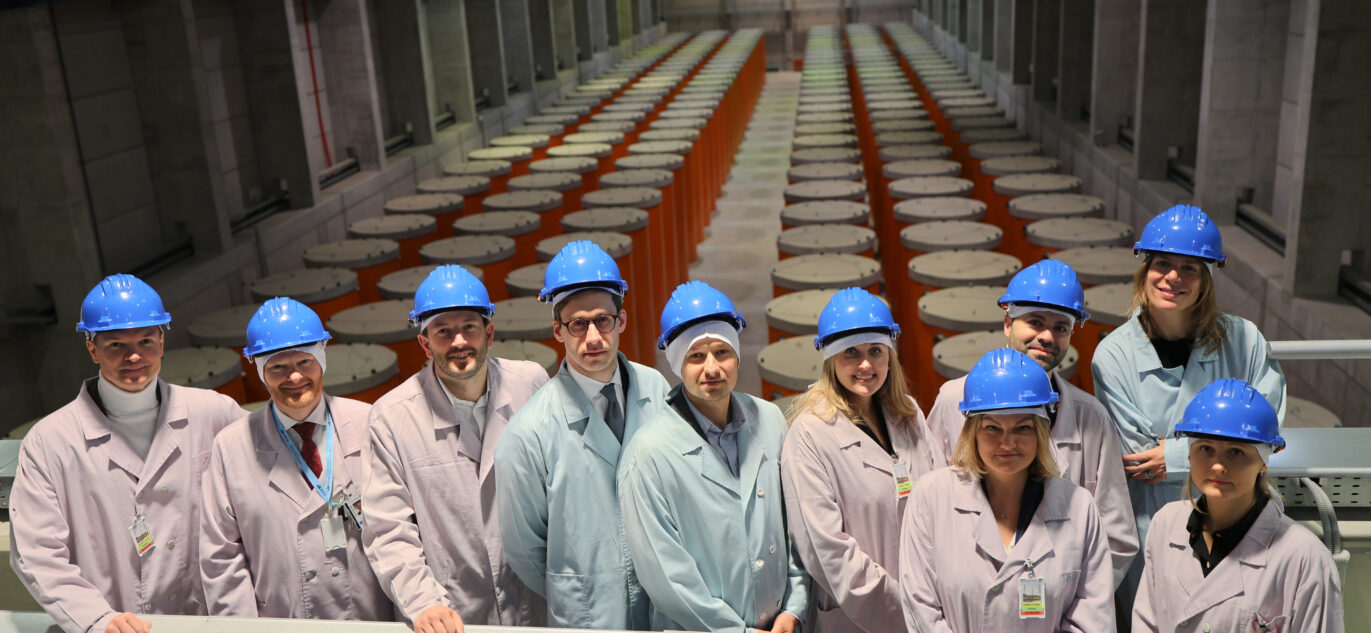
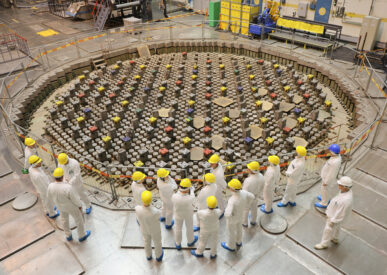
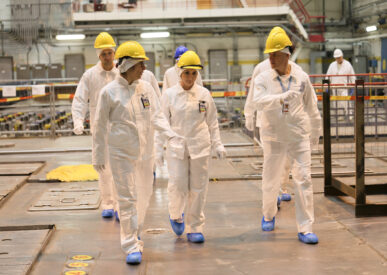
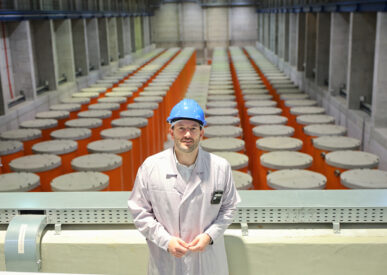
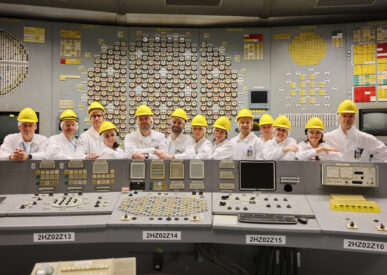
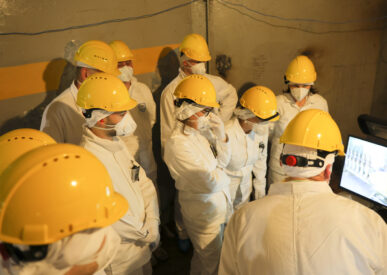
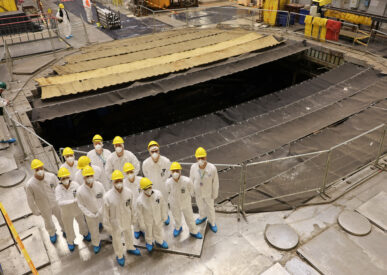
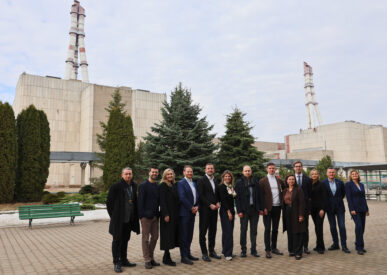
On March 19, representatives of the European Parliament (EP) visited the Ignalina Nuclear Power Plant (INPP), where they were introduced to the progress of the decommissioning of Lithuania’s former nuclear power facility, as well as matters related to operational efficiency and resource management.
The visit was attended by Members of the European Parliament: Virginijus Sinkevičius, who is responsible for INPP decommissioning matters in the European Parliament, Kamila Gasiuk-Pihowicz, Paulius Saudargas, and their accompanying advisors. Also present were Vice Minister of Energy Gabriel Gorbačevski and Visaginas Mayor Erlandas Galaguz.
Currently, the European Parliament is preparing a draft opinion on the European Union (EU) Council Regulation (hereinafter – the Regulation) concerning the support programme for the decommissioning of Lithuania’s Ignalina Nuclear Power Plant for the period 2028–2034, for which a budget allocation of €678 million is proposed. Therefore, it was important for the Members of the European Parliament to assess and observe firsthand the progress of ongoing work, engage with company representatives, and visit the sites where daily dismantling activities are carried out in accordance with the highest safety standards and EU commitments.
“We welcome the attention of Members of the European Parliament at this particular time, as the INPP decommissioning megaproject has reached a new stage – the start of the most technically complex work related to the dismantling of reactor cores. This is one of the most complex nuclear energy projects in Europe, requiring the highest safety standards and consistent international cooperation. The visit of Members of the European Parliament is important for assessing the project’s progress and ensuring continued EU funding for the smooth completion of the remaining work,” emphasized Linas Baužys, Head of “Altra”.
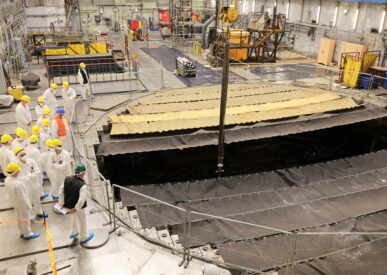
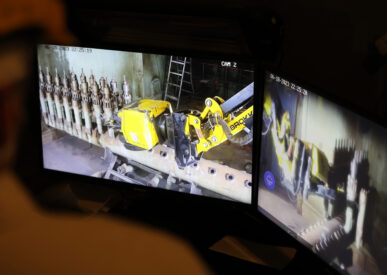
During the visit, the delegation was presented with the progress of the INPP decommissioning project. To date, 81,603 tonnes of plant equipment and structures have already been dismantled, representing 45.3% of the total planned volume. The delegation was also introduced to the upcoming works marking the transition to the most complex stage of the megaproject. These include preparations for reactor dismantling and the dismantling of complex technological equipment – steam drum-separators. These are unique tasks with no direct equivalents worldwide.
Significant attention was also given to radioactive waste management infrastructure. The delegation was presented with the progress of the near-surface repository construction, which began last year, as well as discussions on the expansion of a solid radioactive waste storage facility, where waste generated from reactor dismantling will be temporarily stored in the future.
The visit also covered challenges related to project implementation, safety requirements, long-term planning, and funding needs. It was emphasized that the decommissioning of INPP is not only a national project but also an example of European solidarity and technological leadership, contributing to the long-term safety of the region.
The decommissioning of the Ignalina Nuclear Power Plant is largely financed by European Union funds, with the remaining share covered by the national budget of the Republic of Lithuania. Currently, work is being carried out under the 2021–2027 funding programme, for which the European Union has allocated €552 million. For the 2028–2034 period, €678 million is planned.
The involvement of Members of the European Parliament is important to ensure that decisions regarding the 2028–2034 programme properly reflect the project’s progress and its future needs.
More about the Regulation:
The Regulation aims to support Lithuania in closing the Ignalina Nuclear Power Plant, eliminating residual radiological risks, and optimizing programme efficiency by proportionally reducing the workforce, considering that some projects will be carried out by external contractors (such as the dismantling of reactor R3 zone). It also seeks to develop knowledge on the decommissioning of graphite-moderated nuclear power plants and radioactive waste management for the EU and other countries (e.g., Ukraine). The Regulation defines the objectives of the Ignalina Programme, the budget for 2028–2034, the forms of EU funding, and the rules for granting such funding. The programme will be implemented in accordance with Regulation (Euratom) 2024/2509, following the principle of indirect management with the current entrusted entities (CPVA, EBRD). The final decision on the Regulation will still need to be adopted by the EU Council.