“Altra” Completes a Historic Project in Lithuania: Maišiagala Radioactive Waste Storage Facility Successfully Decommissioned
Press releases
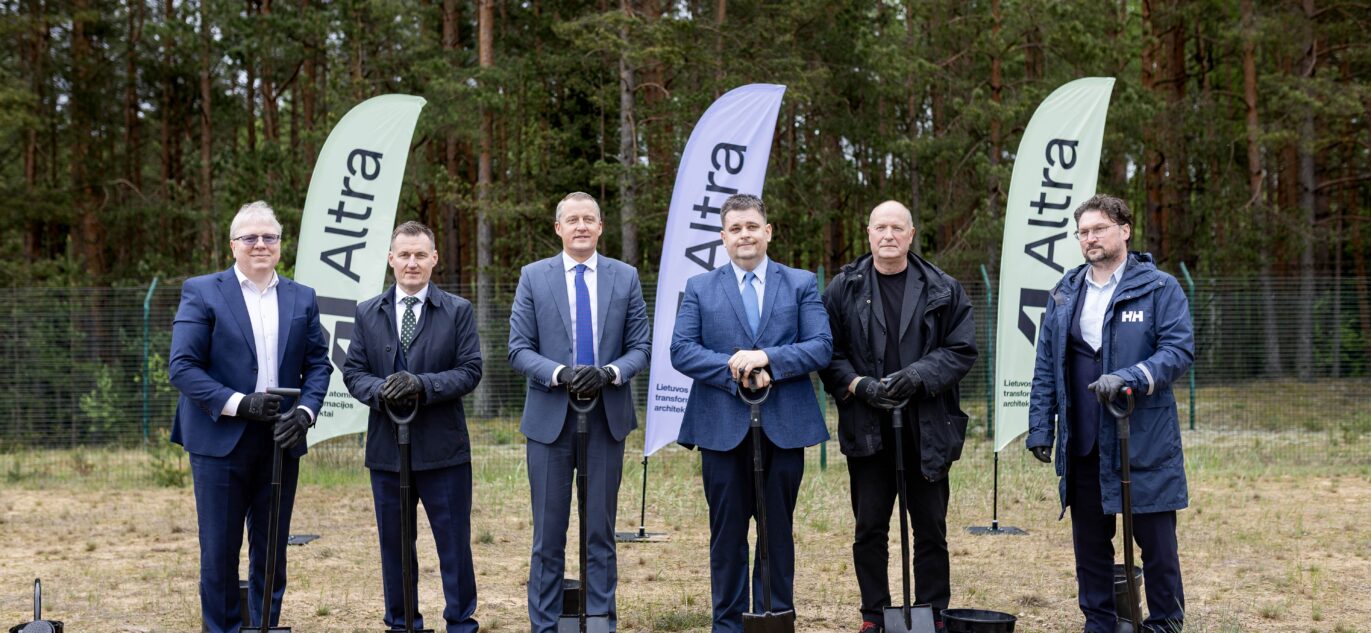
After nearly a decade of work, the Ignalina Nuclear Power Plant, operating under the name “Altra”, has successfully completed the decommissioning project of the Maišiagala Radioactive Waste Storage Facility. All radioactive waste, radionuclide-contaminated structures, and contaminated soil have been removed from the site, and the territory has been cleaned up and restored. Lithuania has become the first country in the world to decommission this type of facility in accordance with the highest international safety standards and using state-of-the-art technologies.
The successful completion of all project activities was officially confirmed by the State Nuclear Power Safety Inspectorate (VATESI), which revoked the decommissioning license for the Maišiagala Radioactive Waste Storage Facility. Following this decision, the site also lost its status as a nuclear facility.
“This is a highly significant project for Lithuania – for the first time, a historic radioactive waste storage facility has been fully remediated and its status as a nuclear facility has been revoked. Through this project, we have demonstrated that Lithuania is among the few countries capable of safely and responsibly implementing nuclear energy projects of such complexity,” says Minister of Energy Žygimantas Vaičiūnas.
The Maišiagala Radioactive Waste Storage Facility was established during the Soviet era in the Širvintos district, in the Bartkuškis forest, covering an area of 2.7 hectares adjacent to the Bartkuškis Telmological Reserve and the Kernavė Cultural Reserve, a UNESCO World Heritage Site. The storage facility, built in 1963, was used for nearly a quarter of a century (1964–1989) to collect and store radioactive waste of various origins from industry, healthcare, research and educational institutions, as well as Soviet military units operating not only in Lithuania, but also in the Kaliningrad and Grodno regions. The waste was disposed of without sorting and with no regard for long-term environmental impact or public safety.
According to Linas Baužys, CEO of “Altra”, this is one of the most significant environmental projects in Lithuania’s energy sector, bringing a decades-long issue to a definitive resolution.
“We have remediated a site that had caused justified public concern for decades and completely eliminated the associated risks. The project was implemented using the most advanced technologies – the majority of the work was carried out using remotely operated and robotic equipment, which allowed us to maximize protection for workers handling radioactive waste from potential radiation exposure. By implementing this project, we not only ensured environmental and public safety, but also accumulated unique experience that strengthens Lithuania’s expertise and international visibility,” notes Linas Baužys, CEO of “Altra”.
As part of the project, approximately 1,570 cubic meters, or 1,292 tonnes, of radioactive waste were removed from the storage facility and packaged into nearly 2,000 packages. The waste was preliminarily identified and sorted before being safely transported to the radioactive waste management facilities of the Ignalina Nuclear Power Plant, where it is further processed and prepared for final disposal in existing and planned repositories. In total, all waste was transported from the storage facility to the nuclear power plant in 257 shipments, ensuring safe transportation throughout the process.
To carry out the work, temporary infrastructure meeting the latest safety standards was installed on site, and advanced equipment, including remotely operated robotic technologies, was used. This ensured the safety of workers, residents, and the environment during the removal of hazardous waste and the implementation of other decommissioning activities.
“One of the greatest challenges in decommissioning the storage facility was the fact that, for decades, different types of radioactive waste with varying levels of radioactivity had been disposed of irresponsibly and without sorting. As a result, waste of different hazard levels and containing various radio nuclides accumulated in a single location. Furthermore, during the facility’s operation, the waste was periodically covered with layers of concrete, making its separation and sorting both technically and organizationally highly complex once retrieval operations began. Although radioactive waste inventory records had been preserved, once we started emptying the storage facility, we also discovered waste packages of unknown origin. Therefore, we worked with the utmost care, continuously assessing the situation and potential risks,” says Dr Gintautas Klevinskas, Head of the Radioactive Waste Repositories Division at “Altra” and Project Manager of the Maišiagala Radioactive Waste Storage Facility Decommissioning Project.
At present, only uncontaminated buildings and infrastructure suitable for further use remain on the site, including administrative buildings, utility networks, roads, communication systems, and security systems. This infrastructure is required for site maintenance, monitoring, and potential future use; therefore, its dismantling was not necessary.
Most of the former storage facility area has now been granted “green field” status, meaning the territory complies with all safety requirements and can be transferred to the state for public use.
For the time being, part of the territory has been temporarily designated as a “brown field” area, where groundwater monitoring will continue. Data from ten groundwater monitoring boreholes installed on site indicate that tritium concentrations fluctuate, and in some periods exceedances of established limits were recorded in several boreholes. For this reason, groundwater monitoring in the “brown field” area will continue for at least two more years. Once it is confirmed that all indicators consistently comply with the established threshold values, this part of the territory will also be reclassified as a “green field”.
“The residual tritium concentrations identified in part of the territory pose no threat whatsoever to the environment or nearby settlements. As a precautionary measure, the use of groundwater for drinking purposes in the ‘brown field’ area is temporarily restricted until stable and safe water quality is confirmed,” notes G. Klevinskas.
The project is regarded as one of Lithuania’s most significant achievements in nuclear safety and environmental protection. It marks the completion of a historic phase, resolves a decades-old issue once and for all, and opens opportunities for future public use of the territory.
More about “Altra”
Today, one of the company’s main objectives is to implement the immediate dismantling of the decommissioned nuclear power plant without leaving future generations an unjustified burden of radioactive waste management. Throughout the entire decommissioning period of the Ignalina Nuclear Power Plant, approximately 180,000 tonnes of equipment and associated materials are planned to be dismantled. The total scale of demolition works and dismantled concrete will reach 1.7 million cubic metres. Around 78% of dismantled equipment and 94% of reinforced concrete is returned to the secondary raw materials market after decontamination, while radioactive waste is managed in accordance with the highest safety standards.
To ensure the proper and final disposal of radioactive waste, four repositories are planned: a repository for short-lived very low-level radioactive waste has already been constructed and is currently in operation; in 2027, permission is expected to be obtained to convert the bituminised radioactive waste storage facility into a repository; by 2028, a new repository for short-lived low- and intermediate-level radioactive waste is planned to be completed; and by 2070, a deep geological repository for spent nuclear fuel and other long-lived radioactive waste is planned to be established.
Surface repositories are being and will continue to be constructed within the company’s territory in the Visaginas Municipality. The final site for the deep geological repository within Lithuania is expected to be confirmed by 2049, with construction and operation planned by 2080. During this period, “Altra” aims to establish itself as an advanced next-generation nuclear energy company and continue successfully developing its activities.